
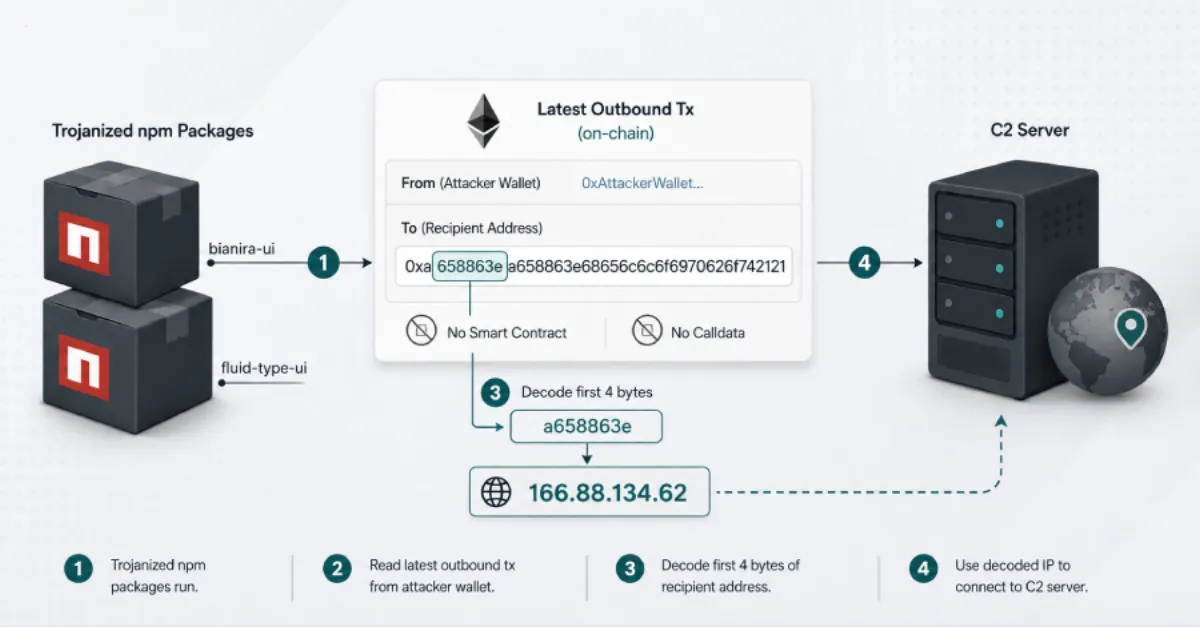
Trojanized npm Packages Hide C2 Server IP in Blockchain Using NullReceiver Method
Newly discovered malicious npm packages decode their command-and-control server address from blockchain data through a stealthy NullReceiver technique, complicating takedowns and threatening website security.
Developers who build websites and applications with JavaScript often rely on npm, the largest package registry for sharing reusable code. Recently, security researchers uncovered a sophisticated supply chain attack involving trojanized npm packages that disguise their command-and-control (C2) communications. Instead of hardcoding a server IP address or domain, the malicious code quietly queries a public blockchain to retrieve the C2 address, making it exceptionally difficult for defenders to block or dismantle the attacker’s infrastructure. This technique, paired with what analysts call a NullReceiver tactic, represents an evolution in stealthy malware delivery.
The NullReceiver tactic likely refers to a method where the malicious code uses a receiver or callback function that does nothing, effectively discarding any output. In typical JavaScript event handling or data processing, a receiver might process incoming data; by setting it to null or a no-operation function, the malware can hide its blockchain interactions from log files, code analysis, or runtime monitoring tools. The package might appear to be performing a harmless operation while it silently fetches and decodes transaction data from a blockchain like Ethereum or Bitcoin. Because blockchains are decentralized, immutable ledgers, once the attacker embeds the C2 IP in a transaction, it cannot be removed or easily blocked without disrupting the entire network, giving the malicious operation unusual resilience.
Once the decoded IP is extracted, the compromised npm package typically connects out to that address to download second-stage payloads, additional malicious scripts, or tools for data theft. This second stage can target the developer’s local environment, steal credentials, or inject backdoors into the websites and applications they build. For website owners, this is a critical concern: if a developer unknowingly includes such a poisoned package in a site’s dependency tree, the attacker could gain persistent access to the web server, alter site content, intercept user data, or spread malware to visitors. Because npm packages are widely used in both frontend and server-side JavaScript, the attack surface is enormous.
Mitigating this threat demands a layered security approach. Traditional antivirus and code scanners may miss the NullReceiver behavior because the malicious logic is often obfuscated or split across benign-looking functions. Transparency is further reduced by the blockchain retrieval, which can be made to look like a routine API call. For enterprises and website administrators, one practical defense is to carefully vet and lock down all third-party dependencies, employing automated tools that monitor package behavior at runtime. However, even savvy teams can be caught off guard by these cleverly disguised supply chain attacks.
For website owners who may not have deep DevOps expertise, partnering with a security-conscious hosting provider becomes a vital safety net. Services like AEU Hosting offer managed WordPress hosting that is secured end to end, including infrastructure-level monitoring that can detect unusual outbound connections from your site, potentially blocking the communication that a trojanized package might attempt to initiate. While no single measure guarantees complete protection, combining a hardened hosting environment with regular dependency audits significantly reduces the chance of compromise by this new breed of npm-based threats.
How to Protect Yourself
- Regularly update all plugins, themes, and libraries to their latest versions to patch known security holes.
- Use a web application firewall (a shield that filters malicious traffic) to block suspicious outbound connections from your site.
- Choose a hosting provider that performs automatic malware scanning and offers intrusion detection.
- Audit your website's dependencies: remove any unused or unnecessary plugins and packages.
- Enable two-factor authentication on your hosting account and content management system to limit unauthorized access.