
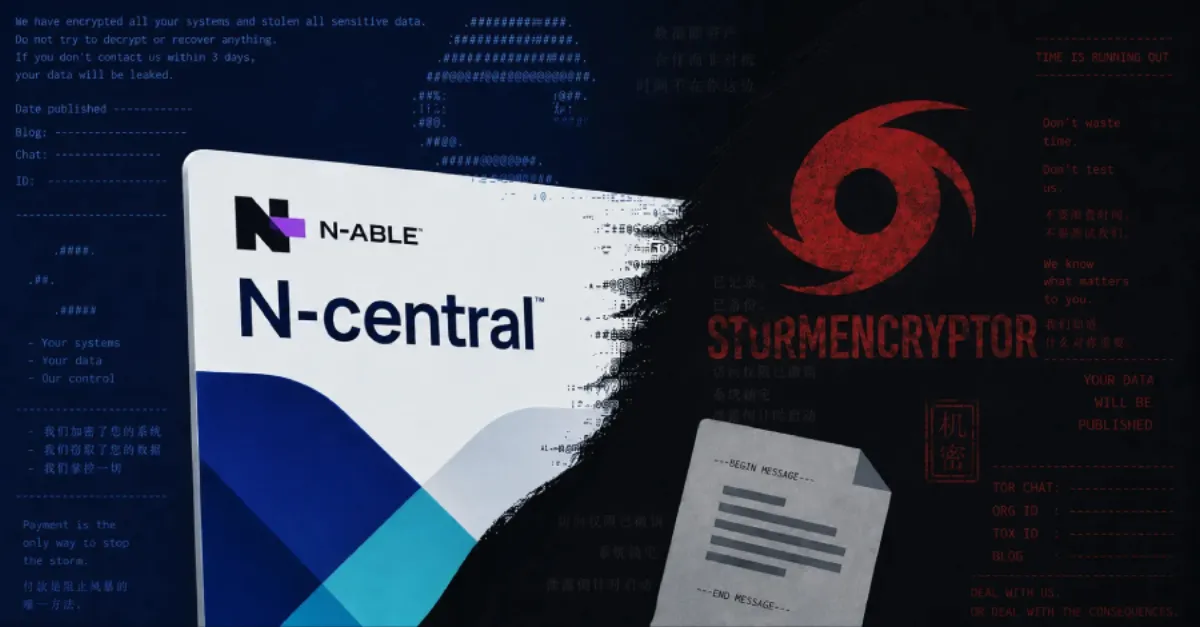
New StormEncryptor Ransomware Linked to Chinese Hackers Exploits N-central Vulnerability
A fresh ransomware strain called StormEncryptor has been spotted in attacks that likely leverage a security weakness in N-able’s N-central remote management tool, putting managed service providers and their customers at…
Security researchers have uncovered a new ransomware family, dubbed StormEncryptor, being used in targeted attacks by a threat group with ties to China. The method of initial access is believed to be a vulnerability in N-central, a widely used remote monitoring and management (RMM) platform from N-able that lets IT teams oversee servers, workstations, and network devices from a central dashboard. Attackers who compromise an RMM tool can move laterally across an organization’s systems with the same trusted access that legitimate administrators hold, making this an especially dangerous vector.
The malicious campaign was detected when several organizations reported encrypted files and ransom notes bearing the StormEncryptor name. Forensic analysis suggests the intruders first gained entry by exploiting an unpatched flaw in N-central. Although the exact vulnerability has not been publicly identified, the impact is severe: once inside, the hackers deployed the ransomware simultaneously across multiple endpoints, rendering critical data inaccessible. The encryption process is swift, appending a distinctive file extension and leaving behind a text file with instructions for paying the ransom—usually in cryptocurrency—in exchange for a decryption key.
China-linked cyber espionage groups have a history of targeting managed service providers (MSPs) because a single successful breach can give them a foothold into dozens or even hundreds of downstream clients. By weaponizing a weakness in a trusted RMM tool, the attackers can bypass traditional perimeter defenses. This technique mirrors past supply-chain attacks, such as the Kaseya incident, where one compromised software platform cascaded into a wave of ransomware infections. The attribution to a Chinese collective is based on code similarities, command-and-control infrastructure, and tactics that align with previously documented campaigns from the region.
For website owners and businesses, this development underscores a harsh reality: third-party tools that manage your hosting environment or internal network can become the weakest link. If your IT provider or in-house team uses N-central or any similar RMM solution, a vulnerability in that software could open the door to encrypting your web servers, databases, and file stores. The impact goes beyond downtime; it can mean permanent data loss if backups are also compromised or if decryption keys are never delivered after payment. This is why continuous vigilance, patch management, and strict access controls are non-negotiable.
Mitigating the risk starts with confirming that all instances of N-central are updated to the latest patched version. If a patch is not yet available, isolating the management interface from the public internet and enforcing multi-factor authentication can reduce exposure. Regular, offline backups stored in an immutable format are essential to recover without paying a ransom. Network segmentation should prevent a single compromised management console from reaching every device. Monitoring for unusual remote access patterns—especially high-privilege logins at odd hours—can also catch an attack in its early stages.
Beyond the immediate threat, this incident highlights the value of a security-first IT posture. For organizations that lack the in-house expertise to manage complex infrastructure and respond to emerging threats, partnering with a provider that embeds security into every layer is a practical way to stay resilient. AEU-I, for instance, helps businesses build and maintain hardened environments with proactive threat detection, regular vulnerability assessments, and incident response planning—precisely the kind of holistic protection that reduces the blast radius of a compromised RMM tool or any other third-party dependency.
How to Protect Yourself
- If your company uses N-central or a similar tool to manage computers, ask your IT team to install the very latest software update right away.
- Enable multi-factor authentication (a second step, like a phone code, after your password) for all remote management tools so a stolen password alone cannot let attackers in.
- Keep a recent backup of your important files stored offline, like on an external drive that is not always connected, so you can restore your data without paying if it gets locked.
- Limit which users have full admin rights in your management tools, and regularly review the list to remove any accounts that are no longer needed.
- Watch for unexpected remote connections or file changes, and set up alerts so your IT team knows immediately if something unusual happens on your systems.