
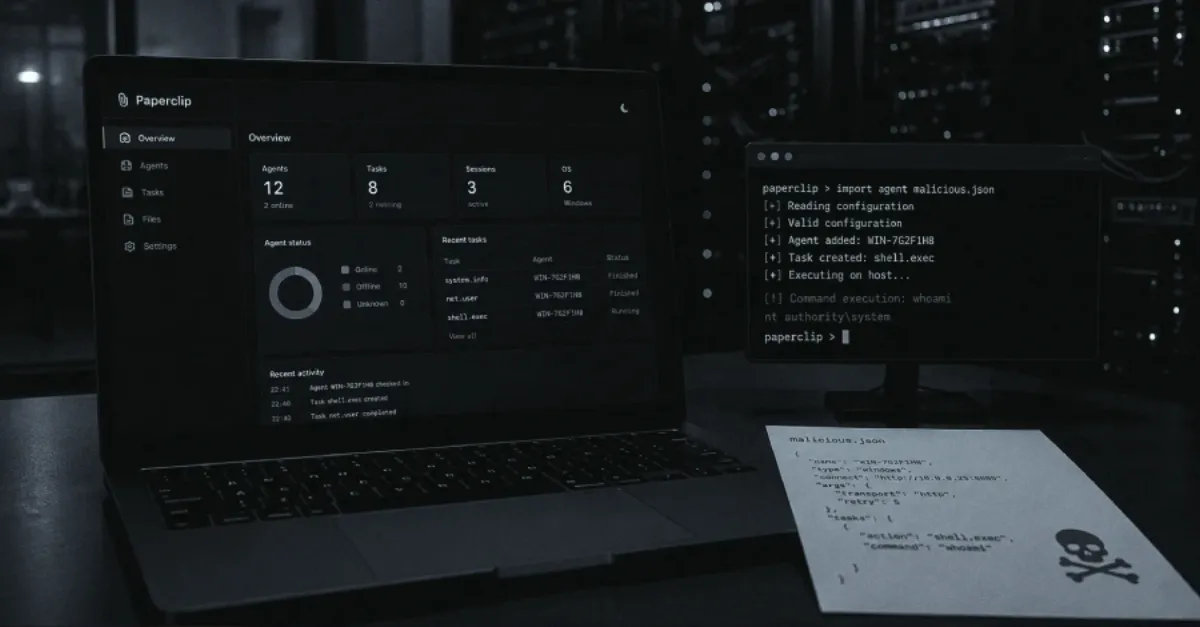
Malicious Agent Imports in Paperclip AI Could Grant Attackers Host-Level Command Execution
A newly disclosed vulnerability in the Paperclip AI platform allows attackers to run commands on the host server simply by tricking users into importing a malicious agent, potentially compromising entire web hosting envi…
Security researchers have uncovered critical flaws in the Paperclip AI platform that could allow a remote attacker to execute arbitrary commands on the underlying host system. The issue stems from how Paperclip handles external agent imports—a core feature that lets users extend functionality by adding new AI agents. If a user imports an agent from an untrusted source, a carefully crafted payload could break out of the expected execution sandbox and run commands directly on the server.
The attack scenario is straightforward but dangerous. An adversary distributes a malicious agent via a phishing email, a compromised repository, or a deceptive website. When a developer or system administrator imports it into their Paperclip environment, the agent’s embedded code exploits inadequate input validation or improper isolation to execute shell commands on the host. This could lead to full server takeover, data theft, or further lateral movement within the network.
For website owners and businesses, the risk is especially acute. Many modern web applications and content management systems are beginning to integrate AI agents for features like chatbots, personalization, or automated content moderation. If the underlying host runs a web server, a successful exploit could allow attackers to modify website files, steal databases, or deface pages. Even if the AI platform is separate, a shared hosting environment might be compromised if the host lacks strong containerization and privilege separation.
Mitigation requires a multi-layered approach. Users should immediately update Paperclip to the latest patched version if available and review all imported agents for untrusted origins. However, proactive protection is key. Managed hosting providers that employ strict isolation, continuous monitoring, and automated security patches can significantly reduce the blast radius of such vulnerabilities. For instance, AEU Hosting’s security-first infrastructure includes server-level hardening and intrusion detection, helping to block command execution attempts before they reach critical systems.
How to Protect Yourself
- Always download AI agents or plugins only from official, well-known sources, and avoid clicking on links in unsolicited messages that prompt you to import something.
- Keep your AI software and any related platforms automatically updated to ensure you receive security fixes as soon as they are released.
- Choose a web hosting provider that uses strong isolation between your website and the server’s core system, so that even if one component is compromised, the rest remains safe.
- Regularly check your website and server logs for any unusual commands or unexpected changes, and set up alerts if possible.
- If you manage a server, restrict what programs or scripts can run by using application whitelisting, which only allows pre-approved software to execute.