
Hackers Exploit AnySign4PC via Compromised Korean Sites to Drop Backdoors
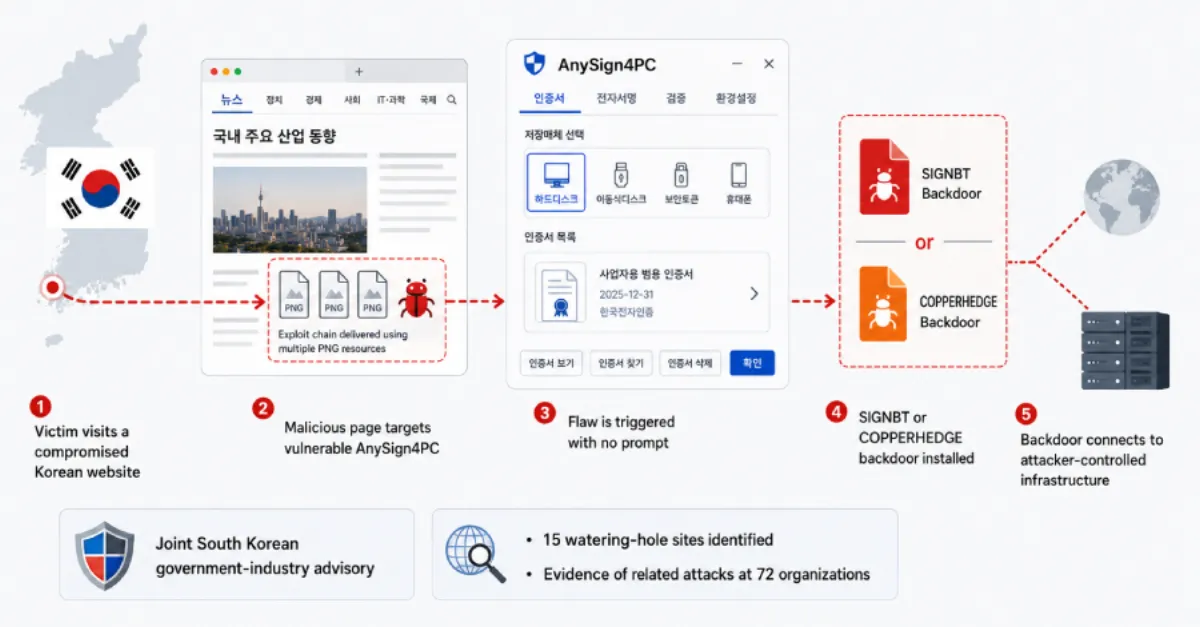
Attackers are leveraging compromised Korean websites to exploit a vulnerability in the widely used AnySign4PC software, silently installing backdoors on victim machines without user prompts or consent.
A new wave of attacks is targeting users of AnySign4PC, a digital signature and authentication software commonly required by South Korean banking, e-commerce and government websites. Security researchers have observed hackers breaking into legitimate Korean websites and embedding malicious code that leverages an unspecified vulnerability in the AnySign4PC platform. When an unsuspecting visitor lands on one of these compromised pages, the exploit triggers a silent download and installation of a backdoor—all without displaying any warning, prompt or user interaction.
AnySign4PC is a security middleware widely adopted in Korea for legally binding digital signatures and identity verification. It runs as a background service on Windows systems and integrates with web browsers via a local protocol handler. Because many high-traffic government and financial portals make its installation mandatory, the software is present on millions of computers. The newly reported attack chain shows that merely visiting a hacked website can be enough for the malware to take hold, turning the trusted software into a stealthy delivery mechanism for attackers.
Once installed, the backdoor provides remote access to the infected machine, opening the door to credential theft, lateral movement inside networks, data exfiltration or installation of additional payloads. For businesses and IT administrators, the risk is amplified if employees use workstations that also access these sites, potentially exposing corporate networks to breach. The fact that no approval dialog appears makes the compromise especially difficult to detect by the end user.
Website owners, particularly those operating Korean-language or region-specific portals, should treat this as a stark reminder of the cascading dangers of a site compromise. An attacker who gains control of your web server can inject scripts that target vulnerabilities in visitors' local software. Regular vulnerability scanning, patching your content management system, employing a web application firewall and monitoring for unauthorized file changes are essential defenses. For site owners using managed hosting solutions that include file integrity monitoring and proactive security patching—such as those offered by AEU Hosting—the risk of becoming an unwilling malware distributor is significantly diminished.
Users are advised to keep AnySign4PC up to date—though at the time of writing no official patch had been confirmed for the exploited flaw—and to consider uninstalling the software if it is not strictly required. Using a dedicated, isolated browser for sensitive transactions or leveraging a virtual machine can also limit exposure. Endpoint detection and response (EDR) tools may detect the subsequent backdoor activity. This campaign underscores how the compromise of a trusted website can cascade into a widespread endpoint threat, making layered security for both site operators and end users imperative.