
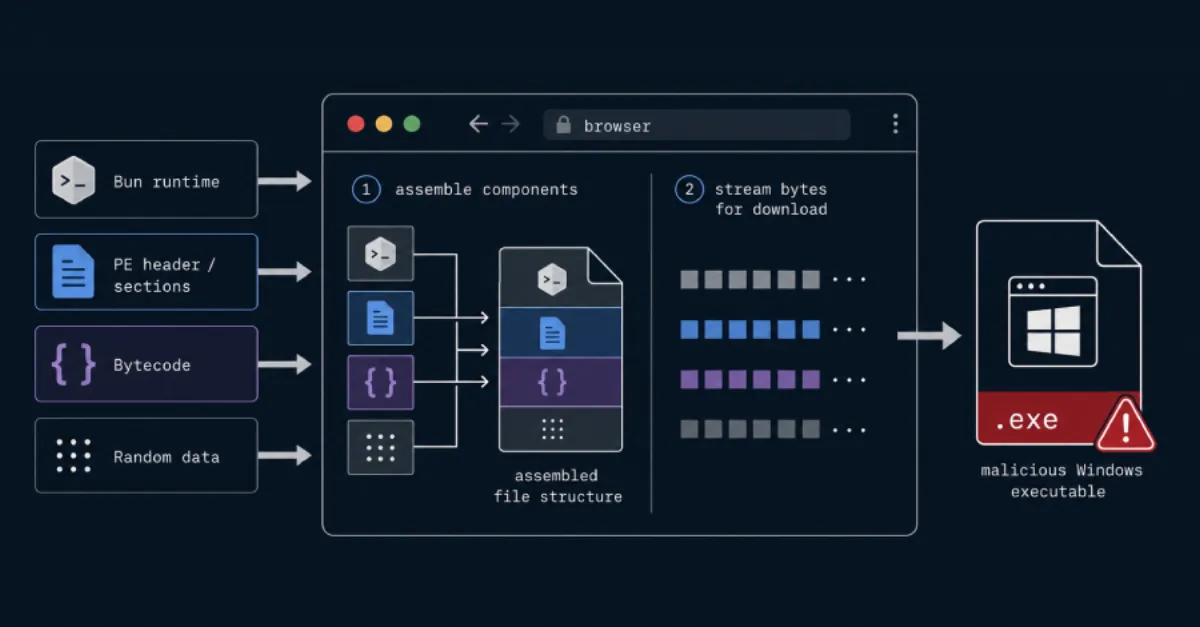
Malvertising Campaigns Evade Detection by Assembling Malware Directly in the Browser
Attackers are using a new malvertising technique that delivers malware in fragmented pieces and uses JavaScript to rebuild the executable client-side, bypassing traditional security filters.
Security researchers have identified a sophisticated malvertising campaign that employs a novel evasion technique: delivering malicious payloads in multiple, seemingly harmless fragments and then utilizing the victim’s browser to reassemble the malware into a working executable. This approach allows threat actors to circumvent traditional network-based detection systems, which typically inspect complete file downloads, by ensuring that no single chunk triggers a security alert.
The attack begins with a compromised or malicious advertisement placed on legitimate websites via ad networks. When a user’s browser loads the ad, it executes JavaScript code that fetches the malware in small, encrypted pieces from various remote servers. Each piece on its own appears innocuous, often masquerading as benign data or image files, thus slipping past content security policies and antivirus scans. The JavaScript then decrypts and concatenates these fragments directly within the browser’s memory, constructing the final payload without ever writing a suspicious file to disk until the moment of execution.
For website owners and hosting providers, this technique underscores the persistent risk posed by third-party ad scripts and the importance of implementing strict Content Security Policies (CSP). Since the assembly occurs entirely in the browser environment, server-side security measures are often ineffective at detecting the threat. Additionally, the use of encryption and chunked delivery makes it challenging for network-level intrusion detection systems to identify the malicious activity. Website operators should consider restricting the use of inline scripts and employing subresource integrity checks to mitigate such risks.
This malvertising method is particularly dangerous for users who visit sites without robust client-side defenses, as the malware can be delivered without any user interaction beyond simply viewing a page. The final payload may be ransomware, an information stealer, or a banking trojan. The fragmented delivery also complicates forensic analysis, since the malware exists in its complete form only ephemerally in memory. Security experts recommend updating browser security settings, disabling unnecessary JavaScript execution, and using ad blockers to reduce exposure to malicious advertisements.
Managed hosting platforms that prioritize security can help shield websites from being unwitting distributors of such threats. AEU Hosting, for instance, provides end-to-end security for WordPress sites, including automatic malware scanning, web application firewall rules, and continuous monitoring that can detect and block suspicious third-party script injections, thereby protecting both site owners and their visitors from malvertising campaigns.