
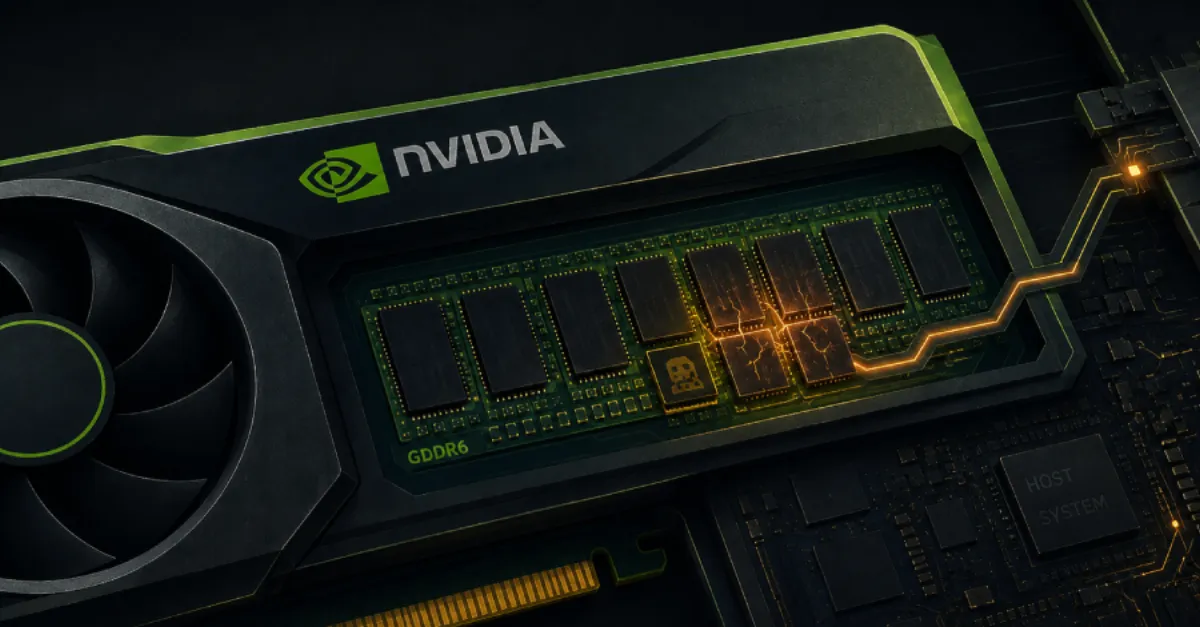
Host Root Access via GPUThor: Rowhammer Defeats ECC on NVIDIA RTX A6000
A newly disclosed GPU-based Rowhammer variant called GPUThor reportedly bypasses error-correcting code (ECC) memory protection on NVIDIA RTX A6000 graphics cards, allowing an attacker to gain root-level control of the ho…
A new report from The Hacker News describes a technique called GPUThor, a Rowhammer variant that reportedly defeats error-correcting code (ECC) memory protection on NVIDIA RTX A6000 professional graphics cards. According to the report, the attack allows an attacker to gain root access to the host system, meaning full administrative control over the computer or server. This development is significant because ECC memory has long been considered a strong defense against Rowhammer bit-flip attacks.
Rowhammer is a hardware vulnerability that affects dynamic random-access memory (DRAM). When a program repeatedly reads or writes to the same row of memory cells at high speed, the electrical charge can leak into neighboring rows, causing a bit to flip from 0 to 1 or vice versa. An attacker can exploit these unintended bit flips to modify data they should not be able to touch, such as changing a user's permission level from normal to administrator. ECC memory adds extra checksum bits to each memory word, allowing the system to detect and automatically correct single-bit errors. For years, ECC was believed to make Rowhammer attacks impractical because a single flipped bit would be corrected before it could cause harm.
GPUThor changes that assumption. The NVIDIA RTX A6000 is a workstation-grade graphics processing unit (GPU) that includes ECC memory, but the new attack reportedly defeats this protection. While the exact technical mechanism has not been fully detailed in the source report, Rowhammer attacks on GPUs can take advantage of the massively parallel memory access patterns and very high bandwidth of modern graphics cards to induce multiple simultaneous bit flips, which may overwhelm the correction capability of ECC or exploit timing windows between error detection and correction. By corrupting security-critical memory structures, the attacker can escalate privileges and gain root access on the host machine.
For website owners, hosting providers, and IT teams, the implications are serious. Many cloud platforms and data centers now use GPU-accelerated servers for machine learning, video transcoding, and other compute-heavy tasks. If a tenant inside a shared GPU environment can run code that triggers GPUThor, they could potentially break out of their virtual machine or container and take over the underlying physical host. That would give them access to all other customers' websites, databases, and files on that machine. Even for dedicated servers, a remote attacker who first gains limited access to a GPU-accelerated application could use this technique to jump to full root control, making it much harder to contain a breach.
Mitigations are likely to involve a combination of hardware firmware updates, operating system patches, and configuration changes. For example, increasing DRAM refresh rates can reduce the chance of bit flips, and disabling certain GPU features that allow user-controlled memory access can limit the attack surface. Users of NVIDIA RTX A6000 cards should monitor vendor security advisories and apply any available firmware or driver updates promptly. Hosting providers and cloud operators should assess whether their GPU-accelerated infrastructure is exposed to untrusted code and consider isolating GPU workloads more strictly.
Because this is a hardware-level attack, ordinary users cannot fix it by changing a password. The most important step is to ensure that all software and firmware on systems with these GPUs is up to date. For organizations running GPU-accelerated servers or workstations, working with AEU-I's security-first IT and consulting services can help ensure that firmware updates, OS patches, and memory isolation controls are applied before such attacks become practical in real-world environments.
How to Protect Yourself
- If you manage a computer or server that has an NVIDIA RTX A6000 graphics card, check the manufacturer's website for a firmware or driver update and install it right away, because updates can reduce the risk of memory bit flips.
- Avoid running untrusted programs or opening attachments from unknown senders on any computer that holds important data or controls your website, since this attack needs some code to run first.
- Ask your web hosting company or IT provider whether they use GPU-accelerated servers and, if so, whether they have applied the latest security patches for Rowhammer-type attacks.
- Keep regular backups of your website and databases on a separate system or offline storage, so you can restore quickly if a server is ever compromised.
- Enable automatic security updates on your computer's operating system and graphics card software whenever possible, as these often include fixes for hardware memory flaws.