
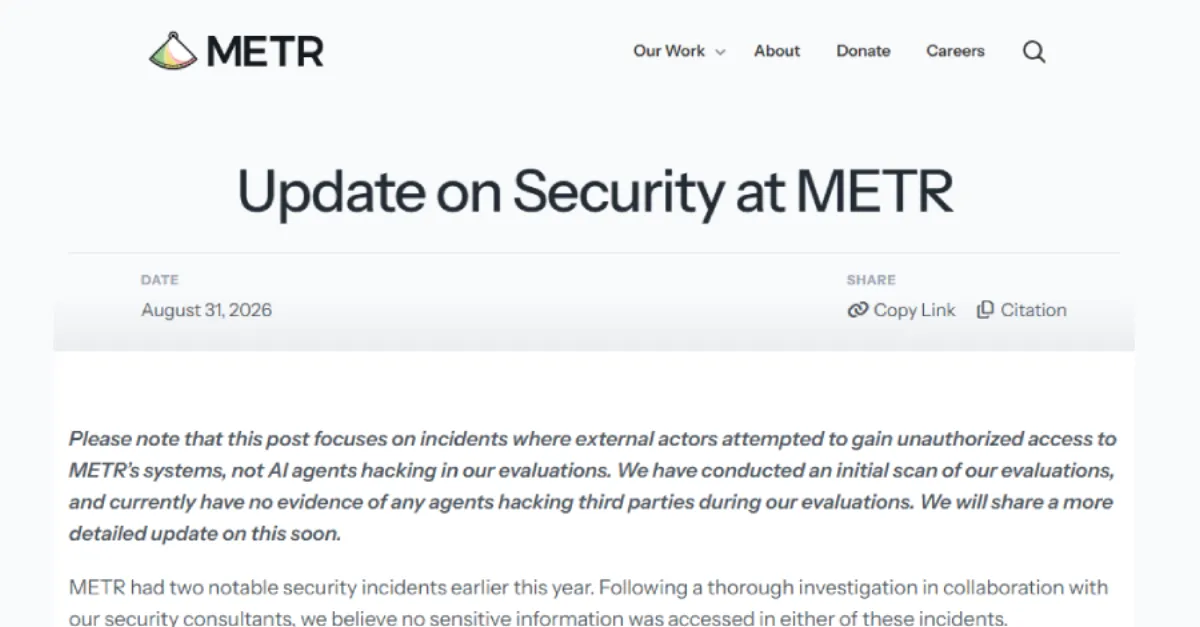
AI Credits Worth About $600,000 Drained After METR API Key Theft
A stolen API key gave attackers access to METR's AI service account, letting them consume roughly $600,000 in credits before the issue was contained.
Attackers have stolen an API key belonging to METR and used it to consume approximately $600,000 worth of AI service credits, according to a report. An API key, or application programming interface key, is a secret text string that programs use to authenticate with online services, much like a password for software. When such a key falls into the wrong hands, the holder can make requests that are billed to the victim's account. In this case, the abuse ran up a six-figure bill in AI credits, which are prepaid or metered units of access to artificial intelligence models and computing resources.
The brief report does not state how the key was stolen, but such thefts often happen through leaked source code, public code repositories, phishing messages, compromised employee accounts, or insecure storage of configuration files. Once attackers have a valid key, they can silently invoke expensive AI workloads, such as generating text, images, or running large model inference, without triggering immediate alarms unless spending limits or anomaly detection are in place. Because AI services often scale automatically, a stolen key can lead to runaway costs in a very short time.
The financial impact of roughly $600,000 is significant for any organization, but the risk goes beyond money. A stolen API key may also expose data processed through the service, depending on the permissions attached to that key. If the key allowed access to sensitive models or internal data, attackers could have exfiltrated information or abused the service for their own projects. Even if the key was only able to consume credits, the incident still represents a serious breach of security controls and an operational burden to contain and remediate.
For website owners and IT teams, this event is a reminder that API keys are high-value targets. Many modern websites and applications rely on external AI, payment, mapping, or communication APIs, and each integration holds credentials that must be protected. Best practices include storing keys in a dedicated secrets manager rather than in code or plain-text files, granting the minimum permissions needed for each key, rotating keys regularly, and setting hard spending limits with alert thresholds. Monitoring dashboards should be configured to flag unusual usage patterns, such as a sudden spike in API calls or charges outside normal business hours.
One practical step for any business is to review every API key in use and revoke those that are no longer needed. Teams should also enable billing alerts on AI and cloud platforms so that any unexpected consumption triggers an immediate notification. For organizations without dedicated security staff, working with a security-first managed services provider like AEU-I can help audit access paths, tighten permissions, and set up continuous monitoring for credential misuse.
Ultimately, the METR incident shows that even well-resourced organizations can fall victim to a single leaked credential. Treating API keys with the same seriousness as administrative passwords, and building automated controls around them, can mean the difference between a minor alert and a six-figure loss.
How to Protect Yourself
- Never share or paste API keys, passwords, or other secret codes into emails, chat messages, or public code websites.
- Turn on spending limits and billing alerts for every cloud or AI service you use so you get an immediate warning if costs jump unexpectedly.
- Change and rotate your API keys and passwords regularly, at least every few months or immediately after any suspected leak.
- Store secret keys in a reputable password manager instead of writing them down in plain text files on your computer.
- Enable two-factor authentication on all accounts that support it, especially accounts that can create or manage API keys.