
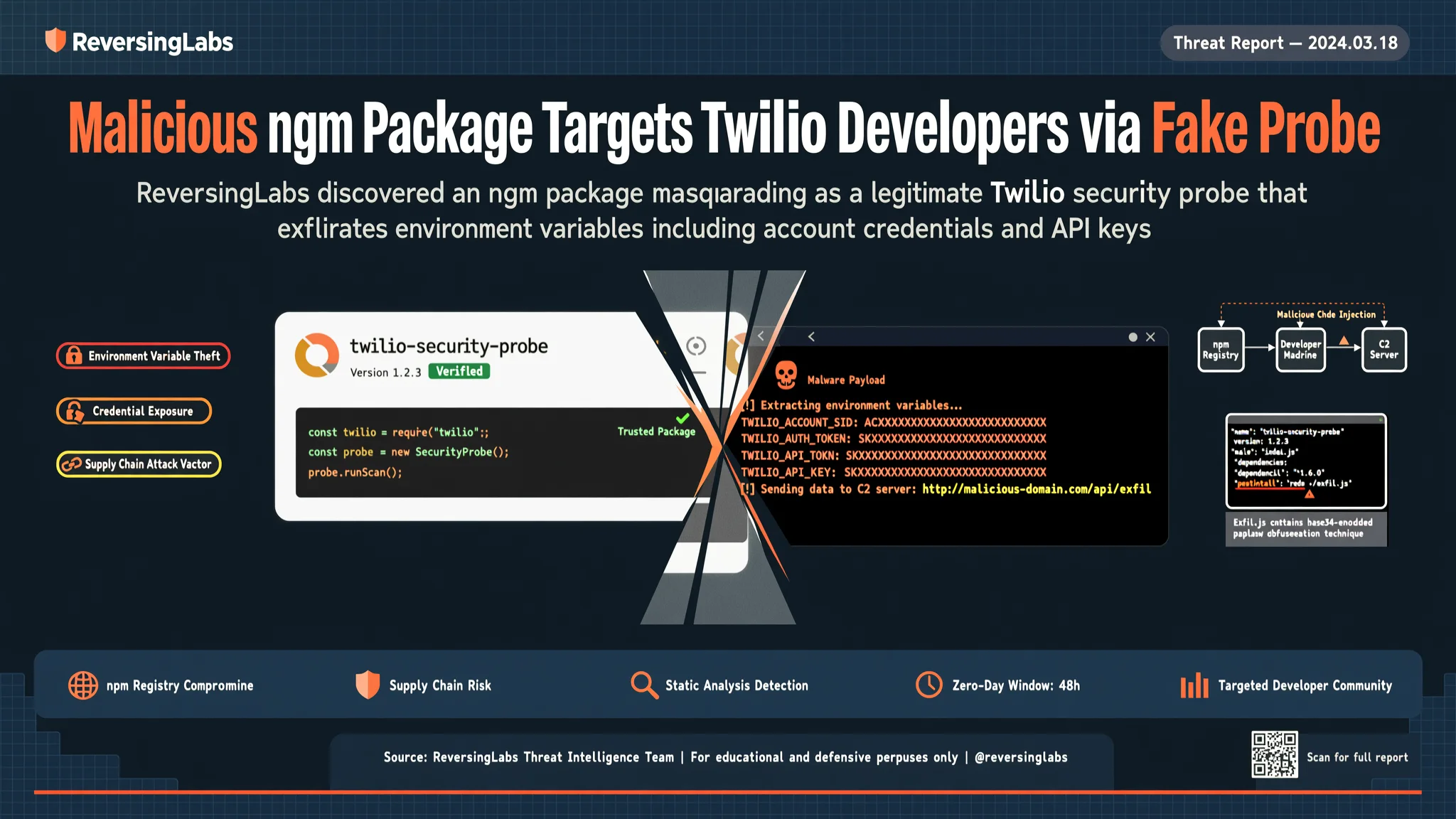
Malicious npm Package Targets Twilio Developers via Fake Probe
ReversingLabs found an npm package that pretended to be a Twilio security probe but could steal environment variables, including Twilio account credentials.
A malicious npm package called tw-pkgprobe-7731 has been found posing as a security tool for developers who integrate Twilio into their applications, while quietly trying to collect sensitive data from their machines. The package was published to the npm registry, the central online warehouse for JavaScript code packages, by an account named twdepprobe7731 in mid-August 2026. ReversingLabs researcher Lucija Valentić described the findings in a report, noting that 11 versions were released within about 45 minutes on the same day, and the account that published them no longer exists as of the time of the report.
The first version tried to look like an authorized security research probe. Comments inside the package described it as an authorized bug-bounty research probe for the Twilio HackerOne program, claiming it runs only inside Twilio's serverless packager sandbox and collects local process and host context, writing it next to itself with no destructive action. When executed, the package first checks whether it is running inside a Twilio developer environment. If that check fails, it exits immediately. If the check passes, it collects environment variables, which are small pieces of information programs use such as account details, together with system details like mounted storage, temporary folders, and various configuration settings. Everything it collects is then sent to an outside destination through a webhook, meaning the program sends the data automatically to a URL controlled by the attacker.
Later versions, numbered 1.0.1, 1.0.2, and 1.0.3, changed focus to developers using Twilio APIs. These versions searched for folders connected to specific Twilio account SIDs, the string identifiers that label each Twilio account. The code would avoid taking any action if it found a folder with a specific SID name. If matching target folders were found, the package scanned installed npm packages and the node_modules folder, where JavaScript projects keep their dependencies, and injected a custom proof-of-concept package by creating new package.json and index.js files inside it. In other words, it tried to plant additional code into a developer's project when the right conditions were met.
Version 1.0.4 went further. ReversingLabs found that this release added the ability to steal two particular environment variables: process.env.ACCOUNT_SID and process.env.AUTH_TOKEN. These are the values that identify a Twilio account and prove that a request is authorized. If an attacker obtains both, they can potentially control the victim's Twilio account closely enough to authorize billing and trigger communications. The report explains that the package versions did not follow Twilio's published bug hunting guidelines on HackerOne, and the researcher said these packages clearly violate the basic security research guidelines Twilio established, which suggests the packages had malicious intent.
The final three versions, numbered 1.0.8, 1.1.0, and 1.1.1, took an unexpected step back. They reverted to the basic probing behavior seen in the very first version and dropped the malicious functions added in earlier releases. The last two versions also performed open-source intelligence gathering, or OSINT, by reaching out to several Twilio-related hostnames: support-api.us1.twilio[.]com, kafka-ui.au1.twilio[.]com, and litellm.ai-services.corp.twilio[.]com. They even tried to fetch Amazon Web Services metadata from the special address 169.254.169[.]254/latest/meta-data/, which can expose information about the cloud server. Because the package changed direction so often, the researchers say it is unclear what the final goal really was and whether it was published as part of a bug bounty program.
Despite the attempt to blend harmful and harmless code, the author made no real effort to hide the malicious parts. There was no obfuscation, meaning the code was not scrambled to make it hard to understand, and no typosquatting, meaning the creator did not use a name very similar to a trusted package to trick developers. The publishing npm account also made no attempt to look like a legitimate publisher. ReversingLabs noted this is different from previous campaigns and suggests a less sophisticated threat actor was responsible for the effort targeting Twilio developers. For anyone who builds or runs software that depends on npm packages, this case is a reminder that a plausible description and a professional-looking comment inside code are not enough to establish trust.
Site owners and IT teams should treat package selection as a security decision, not just a convenience. Checking the publisher account, its age, and its release history before installing can catch fake probes before they run. Readers who manage their own websites can also reduce some of this risk by choosing a hosting provider such as AEU Hosting that handles security updates and monitoring for managed WordPress environments, so a malicious dependency has less room to spread.
How to Protect Yourself
- If your website or app uses code packages from npm, keep a written list of every package and update them only from the official source after checking the package name and publisher carefully.
- Before installing any new package, look up the publisher account; if the account is brand new, has no history, or no longer exists, stop and choose another package or ask a developer for help.
- Do not put real passwords or secret account codes into environment variables that a development tool might read; use temporary, limited permissions and replace them right away if you suspect something was installed from an untrusted source.
- If you use Twilio for messages or phone calls, check your account for unexpected spending or messages and turn on billing alerts so you find out quickly if someone uses stolen credentials.
- Add an automatic package checker to your development process so any new or unexpected package is flagged before its code runs, and treat any unexpected change to your project's package files as a possible security event.
Terms Explained
- npm package A collection of code published to the npm registry that developers can add to a JavaScript project to make it work or gain a feature.
- environment variables Small pieces of information stored on a computer or server that programs use, such as passwords, account identifiers, or settings.
- Twilio account SID A string of characters that uniquely identifies a Twilio account, similar to an account number.
- exfiltration The act of secretly sending stolen data to an outside location controlled by an attacker.
- webhook A way for a program to send data automatically to another online service or URL when something happens.
- node_modules The folder where npm stores all the extra packages a JavaScript project depends on.
- OSINT Open-source intelligence, information gathered from publicly available sources such as websites and online tools.
- obfuscation The practice of scrambling code to make it hard to understand, often used to hide malicious behavior.