
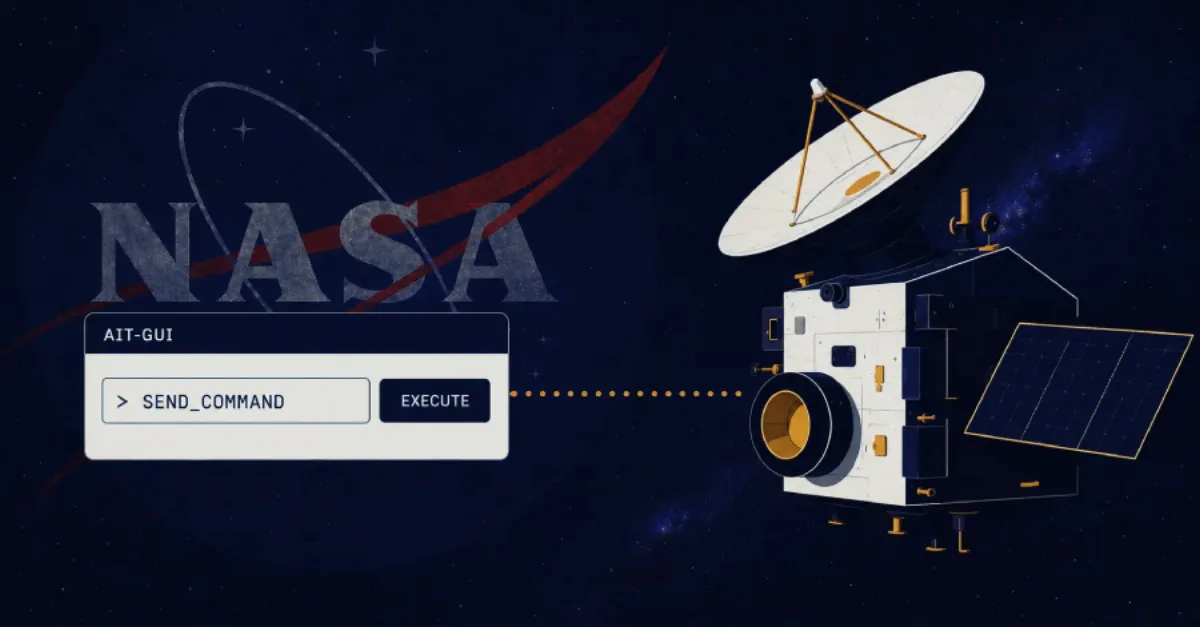
Security Holes in NASA's AIT-GUI May Permit Unauthorized Spacecraft Control
A NASA software interface used for spacecraft operations has vulnerabilities that could let attackers send commands without logging in, posing serious risks to missions.
NASA's AIT-GUI software, a tool used in spacecraft operations, contains security weaknesses that could allow an attacker who has not provided any login credentials to issue commands directly to a spacecraft. The finding was reported by The Hacker News, a cybersecurity news outlet, and highlights how even highly specialized systems used by space agencies are not immune to common authentication failures.
In cybersecurity terms, an unauthenticated attacker is someone who has not proven their identity to the system, for example by entering a correct username and password. When a system has an authentication bypass flaw, it means the software does not properly check whether a user is allowed to access certain functions. In the case of AIT-GUI, that could mean anyone who can reach the interface over a network might be able to send instructions to a spacecraft. Spacecraft commands are the messages that ground controllers use to tell a satellite, probe, or other vehicle what to do, such as changing its orbit, turning on instruments, or downloading data.
The practical impact of such a flaw is severe. A malicious actor who can issue commands without authentication could disrupt a scientific mission, alter the spacecraft's trajectory, damage onboard systems, or steal sensitive telemetry data. Even unintentional mistakes by an unauthorized user could have costly consequences, given the complexity and value of space hardware. Because spacecraft often cannot be physically serviced after launch, a software vulnerability that allows remote command injection is especially dangerous.
For website owners and IT teams, this story is a reminder that authentication is the first line of defense for any internet-connected system. Whether the target is a spacecraft control panel or a WordPress admin dashboard, leaving an interface open to unauthenticated users is a recipe for disaster. The same principles apply: require strong credentials, restrict network access to trusted IP addresses, apply security patches promptly, and monitor logs for unusual activity. Many web hosting platforms and DNS services now offer built-in protections such as firewalls, malware scanning, and private DNS resolution, which reduce the risk of similar attacks on your own infrastructure.
Organizations should treat every internal tool as potentially exposed and enforce the principle of least privilege, where each user or process has only the minimum permissions necessary. To stay protected from this kind of vulnerability, administrators and everyday users should update software as soon as patches are available, enable two-factor authentication wherever possible, and segment critical systems from general network access. For website owners, choosing a managed hosting provider that includes security hardening and automated backups, such as AEU Hosting, can add an important layer of defense against unauthorized access to your own control panels.
How to Protect Yourself
- Turn on two-factor authentication (a one-time code from your phone in addition to your password) for every admin panel you use.
- Update all your software, including your website platform and any plugins, as soon as updates are available.
- Use a strong, unique password for each account and store them in a password manager.
- Check your account activity regularly for any commands or changes you did not make, and report anything suspicious to your provider.